
Which Is Better for Your Application?
The engineer selects the fan. The maintenance crew lives with it.
And sometimes, those two have very different opinions on what makes a good design.
When selecting an industrial centrifugal fan, most conversations begin with airflow (CFM), static pressure, and motor horsepower.
But there's another decision that can have a significant impact on performance, maintenance, and long-term operating costs:
Should you choose a belt-driven or direct-drive centrifugal fan?
Both configurations are widely used in industrial ventilation, manufacturing, HVAC, and process applications. Both can deliver reliable performance when properly selected.
The difference often comes down to what happens after the fan is installed.
Understanding the Difference
A centrifugal fan uses a rotating impeller to move air or process gases through a system. The drive arrangement determines how power is transferred from the motor to the fan wheel.
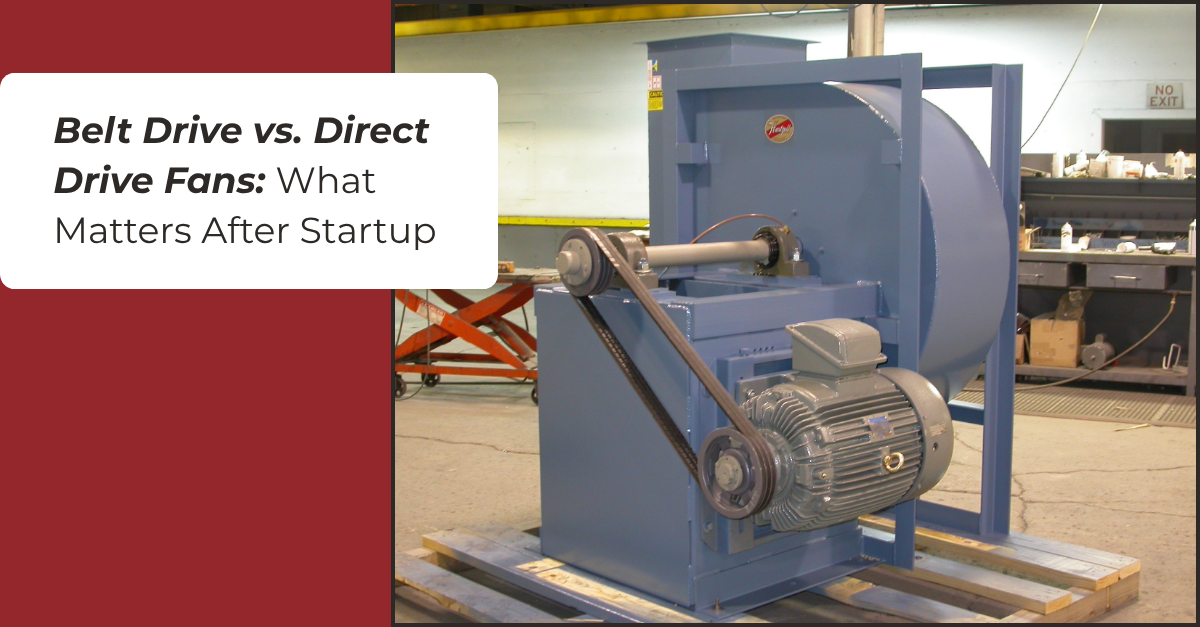
Belt-Driven Centrifugal Fans
In a belt-driven arrangement, the motor transfers power to the fan shaft through belts and sheaves.
By changing the sheave ratio, the fan wheel can operate at a different speed than the motor.
This provides flexibility when a particular wheel speed is needed or when system requirements change.
Direct-Drive Centrifugal Fans
With direct drive, the fan wheel is connected directly to the motor shaft or through a coupling, depending on the arrangement.
There are no belts or sheaves to maintain.
Direct-drive fans can also incorporate variable-frequency drives (VFDs) to adjust operating speed when the motor and fan are designed for variable-speed operation.
1. Maintenance: The Cost Nobody Wants to Think About
🔧 A belt may not cost much. Getting to it can be another story.
Belt-driven centrifugal fans require periodic inspections, belt tension adjustments, alignment checks, and eventual belt replacement.
For a fan installed at ground level with easy access, these tasks may be relatively straightforward.
But what about a fan installed on a rooftop, above production equipment, or in a difficult-to-access mechanical space?
Suddenly, routine maintenance becomes a much bigger consideration.
Direct-drive fans eliminate belt and sheave maintenance, although motors, bearings, and other components still require appropriate inspection and service.
The takeaway: Consider the accessibility of the fan and the cost of downtime, not just the cost of replacement parts.
2. Speed Control: Mechanical Flexibility vs. Electronic Control
One of the traditional advantages of belt-driven centrifugal fans is the ability to adjust wheel speed by changing sheave ratios.
This can be particularly useful during commissioning when actual system resistance differs from the original design.
Direct-drive fans typically rely on motor speed control, such as a VFD, when variable airflow is required.
However, VFDs aren't exclusive to direct-drive fans. Belt-driven fans can also operate with VFDs when properly designed.
An important consideration is how changing speed affects fan performance.
For a centrifugal fan operating under conditions where the fan affinity laws apply:
Airflow (CFM) changes approximately in proportion to fan speed.
Pressure changes approximately with the square of fan speed.
Power requirement changes approximately with the cube of fan speed.
For example, increasing fan speed by 10% can increase the required power by approximately 33% at corresponding operating points.
That's a significant difference, particularly when motor horsepower is already close to its limit.
The takeaway: Before changing sheaves or increasing VFD speed, verify the fan performance curve, motor capacity, and maximum allowable fan RPM.
3. Motor Location and Operating Temperature
Not every centrifugal fan moves clean, room-temperature air.
Industrial applications may involve elevated temperatures, moisture, corrosive fumes, or contaminated airstreams.
In many belt-driven arrangements, the motor can be positioned outside the process airstream.
This can be advantageous when handling air or gases that would otherwise require specialized motor protection.
However, direct drive doesn't automatically mean the motor must be exposed to the airstream. Certain direct-coupled configurations also allow external motor placement.
The specific fan arrangement and materials of construction are critical.
The takeaway: Evaluate the process temperature, airstream composition, and motor location before deciding which drive configuration is appropriate.
4. Efficiency: Is Direct Drive Always Better?
⚡ Not necessarily.
Direct-drive fans eliminate the mechanical transmission losses associated with belts and sheaves.
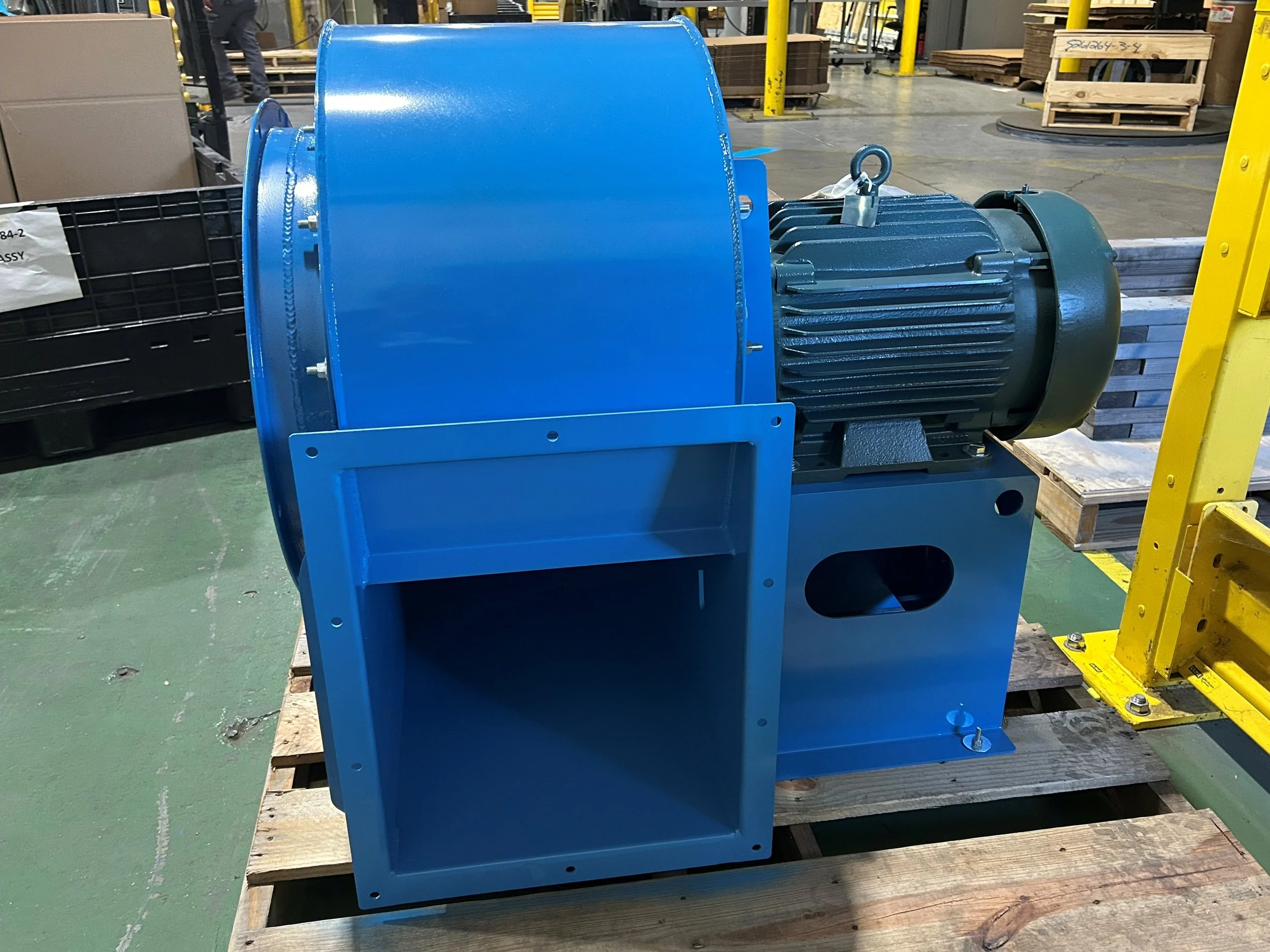
That can provide an efficiency advantage.
But it doesn't automatically mean every direct-drive fan will consume less energy than every belt-driven alternative.
Overall efficiency depends on several factors, including:
Fan wheel design and efficiency
Actual operating point on the fan curve
Motor efficiency
Drive losses
Speed-control strategy
System resistance
A properly selected belt-driven centrifugal fan operating near its best efficiency point may consume less energy than a poorly selected direct-drive alternative.
The important comparison is the total electrical power required to deliver the specified airflow and pressure, not simply the drive arrangement.
5. Initial Purchase Price vs. Long-Term Operating Cost
Here's where the conversation gets interesting.
A lower equipment purchase price doesn't always mean a lower total cost of ownership.
Consider two centrifugal fans that meet the same operating requirements.
One is belt-driven, with convenient maintenance access and relatively constant operating conditions.
The other is direct-drive, eliminating routine belt maintenance but potentially requiring a different motor or control arrangement.
Which is the better investment?
That depends on the installation.
For applications operating continuously, even relatively small differences in electrical consumption can accumulate over thousands of operating hours.
Likewise, avoiding a maintenance shutdown may be worth considerably more than the price difference between two fan configurations.
The takeaway: Evaluate the installed cost, energy consumption, maintenance requirements, and expected equipment life rather than comparing purchase prices alone.
So, Which Centrifugal Fan Drive Is Better?
There isn't one answer for every application.
A belt-driven centrifugal fan may be the right choice when mechanical speed flexibility, motor positioning, or a specific operating speed is important.
A direct-drive fan may make more sense when minimizing routine maintenance, reducing drive components, or simplifying the equipment arrangement is a priority.
And in many applications, both can work.
The key is evaluating the entire installation rather than selecting a fan based on airflow and static pressure alone.
Work With BA Associates on Your Next Centrifugal Fan Application
At BA Associates, we work with industrial OEMs, engineers, contractors, and end users throughout New England, New York, and New Jersey to help select centrifugal fans and blowers for a wide range of applications.
With access to multiple industrial fan manufacturers, we can evaluate different wheel designs, drive arrangements, materials of construction, and operating requirements to identify a solution that fits the application.
Whether you're designing a new system, replacing an existing fan, or evaluating ways to improve performance, we're happy to help.
Selecting a centrifugal fan? Let's make sure it's the right one for the application.
Visit www.BA-Assoc.com or contact us at (603) 210-2479.