
Applications, Benefits & Design Considerations for Industrial Equipment
What if your industrial oven or dryer doesn't need a traditional fan housing?
In many applications, it doesn't.
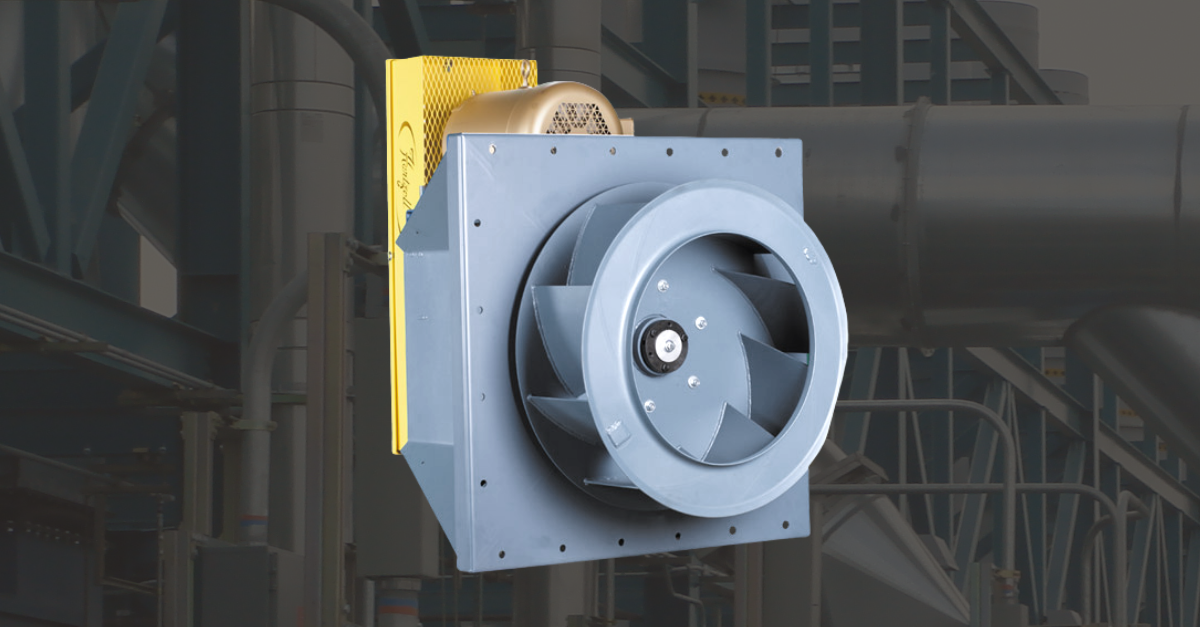
Industrial ovens, dryers, heat-treating equipment, and other process systems often require large volumes of air to be circulated through an enclosed space.
Traditionally, a centrifugal fan uses a scroll-shaped housing to collect air leaving the fan wheel and direct it toward a discharge opening.
But what happens when the equipment already has an enclosure that can accommodate the fan?
That's where industrial plug fans come into play.
Plug fans offer equipment manufacturers a compact, flexible way to circulate air within process equipment. However, eliminating the traditional fan housing introduces several important design considerations.
Understanding how plug fans work, where they perform best, and how the surrounding equipment affects airflow is essential to selecting the right fan for an application.
What Is a Plug Fan?
A plug fan is a type of centrifugal fan that operates without a conventional scroll housing.
Instead of directing airflow through a dedicated volute, the rotating impeller draws air into its inlet and discharges it radially into the surrounding enclosure or plenum.
The equipment's existing structure becomes part of the overall airflow system.
Plug fans commonly use backward-inclined or airfoil-style impellers, although available wheel designs vary by manufacturer and application.
They can be configured with direct-drive or belt-drive arrangements, depending on the operating temperature, motor location, and speed requirements.
The key difference?
A traditional housed centrifugal fan provides a defined airflow path through its housing. A plug fan relies much more heavily on the surrounding enclosure to establish the desired airflow pattern.
That makes equipment design particularly important.
Why Are Plug Fans Used in Industrial Ovens and Dryers?
🔥 When temperature uniformity matters, airflow matters.
Consider an industrial drying oven.
The equipment may require heated air to circulate continuously around products traveling through the process.
The goal isn't necessarily to exhaust air from the building. It's to move heated air throughout the equipment, maintaining consistent temperatures and supporting the drying process.
A plug fan can be installed directly into the oven's recirculation system, moving air through heating sections, ductwork, distribution plenums, or product zones.
Common applications include:
Industrial drying and curing ovens
Heat-treating equipment
Paint finishing and coating systems
Food processing and drying equipment
Industrial furnaces and thermal processing systems
Custom OEM air-handling and process equipment
In these applications, plug fans can provide an alternative to conventional housed centrifugal fans while allowing manufacturers greater flexibility in equipment layout.
However, the benefits depend heavily on the enclosure design and the operating conditions.
Five Important Plug Fan Design Considerations
A plug fan may appear mechanically simpler than a housed centrifugal fan.
But removing the scroll housing doesn't eliminate the need for careful engineering.
In some respects, it makes the system design even more important.
1. Inlet Clearance and Airflow Restrictions
⚙️ A fan can't move air that can't reach its inlet.
One of the most important considerations when installing a plug fan is ensuring adequate clearance around the fan inlet.
If the inlet is positioned too close to an enclosure wall, structural member, or other obstruction, the incoming airflow may become restricted or uneven.
This can result in reduced airflow, increased turbulence, additional noise, or operation away from the intended performance point.
The required clearance depends on the fan geometry and manufacturer's installation recommendations.
For OEM engineers, this means evaluating the fan's physical location early in the equipment design process.
Waiting until the enclosure is already fabricated can leave limited options for correcting airflow problems.
2. Enclosure Design and Internal Obstructions
With a housed centrifugal fan, the scroll helps collect and direct the air leaving the wheel.
A plug fan doesn't have that same built-in discharge path.
Instead, the surrounding enclosure influences how air moves away from the impeller.
Internal walls, heating elements, structural supports, and duct transitions can all affect airflow distribution.
For example, a plug fan installed in an industrial oven may need to move air through a heating section before distributing it across a product conveyor.
Poorly positioned obstructions can create unwanted pressure losses or uneven airflow patterns.
The takeaway: The fan and enclosure should be evaluated as a complete system, not as two independent components.
3. Operating Temperature and Motor Location
🔥 Moving air at 70°F is one thing. Moving it at 500°F is another.
Industrial plug fans are frequently used in elevated-temperature applications.
However, not every plug fan is suitable for high-temperature service.
The operating temperature influences several equipment selections, including:
Fan wheel and shaft materials
Bearing arrangements and lubrication
Motor location and temperature exposure
Shaft seals and thermal protection
Allowable fan speed and mechanical construction
In many high-temperature applications, the motor and bearings can be positioned outside the heated process enclosure.
This helps protect components that may not be rated for the full process temperature.
Depending on the design, additional features such as shaft cooling arrangements, insulation, or specialized materials may be required.
It's important to distinguish between the temperature inside the enclosure and the actual temperatures experienced by the fan's individual components.
The takeaway: Always verify the manufacturer's temperature ratings for the complete fan arrangement, not just the impeller material.
4. Fan Performance and System Resistance
One common misconception is that a plug fan doesn't need to overcome static pressure because it operates inside an enclosure.
That's not the case.
Even when a fan is circulating air within a closed process system, it must overcome resistance from components such as heating coils, filters, ductwork, dampers, and internal flow passages.
The required airflow and pressure determine where the fan operates on its performance curve.
And unlike a conventional housed fan, plug fan performance can be particularly sensitive to the surrounding installation geometry.
For this reason, it's important to understand the conditions under which the manufacturer's performance data was developed.
A fan selected from a published performance curve may not deliver identical results when installed in a restrictive or poorly designed enclosure.
The takeaway: Proper fan selection requires both a defined duty point and an understanding of the installed airflow path.
5. Maintenance and Accessibility
🔧 The easiest time to plan for maintenance is before the equipment is built.
Plug fans are often incorporated directly into large OEM assemblies.
Once the equipment is installed, access to the fan may be limited by panels, insulation, ductwork, or nearby machinery.
Before finalizing the design, consider how maintenance personnel will access the motor, bearings, shaft, and impeller.
Will the fan assembly need to be removed for service?
Can the motor be accessed without dismantling major portions of the equipment?
Is there sufficient clearance to inspect or clean the fan wheel?
These questions may not seem critical during the initial design phase, but they can have a significant impact on long-term equipment maintenance.
Are Plug Fans More Efficient Than Traditional Centrifugal Fans?
Not necessarily.
Removing the scroll housing doesn't automatically improve fan efficiency.
A plug fan's performance depends on the impeller design, operating point, and surrounding enclosure.
In a well-designed system, a plug fan may offer an effective solution for moving large volumes of process air without requiring a separate scroll housing.
However, poor inlet conditions, excessive turbulence, or restrictive enclosure geometry can reduce overall system performance.
When comparing plug fans with housed centrifugal fans, engineers should evaluate the total power required to deliver the desired airflow through the actual system.
The most efficient solution is the one that meets the application requirements with the lowest practical energy consumption, while accounting for installation and operating constraints.
Common Mistakes When Selecting an Industrial Plug Fan
Several issues are worth addressing before equipment design is finalized.
Selecting the fan before defining the enclosure.
Without understanding the surrounding geometry, it can be difficult to predict how the fan will perform once installed.
Underestimating system pressure losses.
Even recirculating systems have resistance. Heating sections, filters, and internal flow passages must be considered.
Ignoring temperature limitations.
High-temperature air can affect bearings, motors, shafts, and other components differently.
Overlooking maintenance access.
A fan that is difficult to inspect or service can create unnecessary downtime.
Assuming published fan performance will exactly match installed performance.
Manufacturer performance data should be evaluated alongside the actual installation conditions and any applicable system effects.
Frequently Asked Questions About Plug Fans
What is the difference between a plug fan and a centrifugal fan?
A plug fan is a type of centrifugal fan. The primary difference is that a plug fan operates without a conventional scroll housing, typically discharging air into a surrounding enclosure or plenum.
Can plug fans be used in high-temperature applications?
Yes. Plug fans are commonly used in industrial ovens, dryers, and thermal processing equipment. However, the allowable temperature depends on the fan construction, materials, motor arrangement, bearings, and other components.
Do plug fans require ductwork?
Not necessarily. Many plug fans are installed directly into equipment enclosures or plenums. The surrounding equipment provides the airflow path, although ductwork may still be incorporated into the overall system.
Can plug fans use variable-frequency drives?
Yes, when the motor and fan assembly are suitable for variable-speed operation. Engineers should verify the allowable speed range, motor requirements, and fan performance before specifying a VFD.
Are plug fans suitable for continuous operation?
Many industrial plug fans are designed for continuous-duty applications. The suitability of a particular fan depends on its mechanical design, operating temperature, speed, and application requirements.
Selecting the Right Plug Fan for Your Equipment
The fan is only one part of the airflow system.
For OEMs designing industrial ovens, dryers, and process equipment, the interaction between the fan and the surrounding enclosure can be just as important as the fan's published performance.
Airflow requirements, static pressure, operating temperature, motor placement, maintenance accessibility, and enclosure geometry should all be considered during the design process.
At BA Associates, we work with OEM engineers, equipment manufacturers, and industrial customers to evaluate centrifugal fan and blower applications.
Representing established industrial fan manufacturers, including Hartzell Air Movement and American Fan Company, allows us to review different equipment configurations and help identify solutions suited to the application.
Whether you're developing a new piece of equipment or improving an existing process, our goal is to help you select equipment that performs reliably in the real world.
Designing an industrial oven, dryer, or process air system?
Contact BA Associates to discuss your airflow, temperature, and equipment requirements.
BA Associates, LLC
www.BA-Assoc.com
(603) 210-2479