When the Right Pump Doesn’t Fit: Custom Pump Engineering for OEM Equipment
Selecting a pump usually starts with the numbers.
Flow. Pressure. Fluid. Temperature. Materials of construction. Motor requirements.
But for OEM equipment manufacturers, there’s another specification that can be just as important:
Will it actually fit inside the machine?
We recently worked on an application where the pump could meet the required hydraulic performance, but the OEM had an extremely tight installation envelope. A conventional mounting arrangement simply wasn’t going to work.
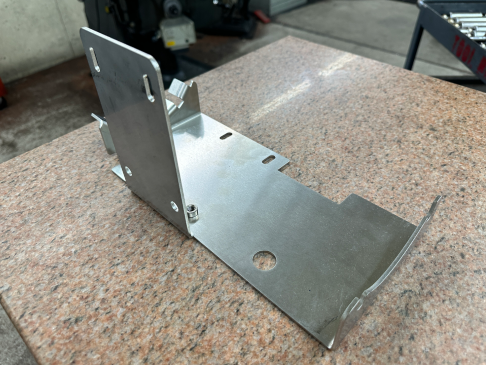
Rather than forcing the customer to redesign their equipment around the pump, the MTH Pumps engineering team designed a custom motor mounting bracket specifically for the application.
It’s a relatively simple-looking piece of fabricated metal.
But sometimes that's exactly what good engineering looks like.
OEM Pump Selection Goes Beyond the Pump Curve
For a traditional pump application, there may be plenty of room for a standard base-mounted pump and motor.
OEM equipment can be very different.
When a pump is being incorporated into a piece of machinery, skid, cooling system or packaged process system, the pump becomes one component within a much larger design.
Engineers may be working within strict limitations for:
Overall equipment dimensions
Pump and motor orientation
Suction and discharge locations
Piping clearances
Electrical connections
Service and maintenance access
Weight
Vibration
Motor frame size
Mounting locations
The pump may be hydraulically perfect and still be completely wrong for the machine.
That's why OEM pump applications often require looking beyond the catalog.
The Challenge: A Very Tight Installation
In this particular application, the OEM needed an MTH pump incorporated into an existing equipment design with very limited available space.
The hydraulic requirements could be handled.
Packaging the pump and motor into the available space was the challenge.
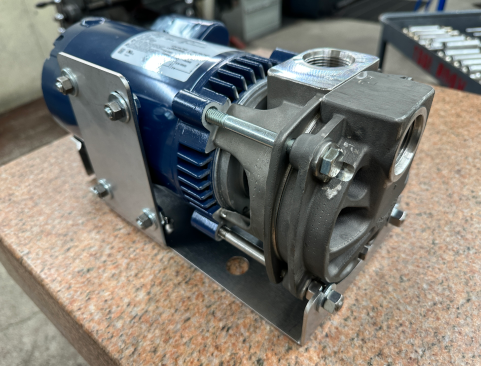
The MTH engineering team developed a custom mounting bracket that allowed the pump and motor assembly to fit the customer's installation while providing a practical, repeatable mounting arrangement.
The finished assembly is a good example of something we see frequently when working with OEMs:
Sometimes the right pump still doesn't fit.
And the solution isn't necessarily selecting a different pump.
Sometimes the better solution is engineering the installation.
Why Customization Matters to OEMs
Changing a pump isn't always a simple decision for an equipment manufacturer.
A different pump can mean different connection locations, different dimensions, different electrical requirements and potentially different hydraulic performance.
Those changes can ripple through the rest of the machine.
Piping may need to move.
Sheet metal may need to change.
Electrical layouts can be affected.
Service access can change.
The equipment footprint might even have to increase.
A relatively small modification to the pump assembly can sometimes avoid much larger modifications elsewhere in the machine.
That's where having access to the manufacturer's engineering team becomes particularly valuable.
From One Prototype to a Repeatable Production Solution
There is another important consideration with OEM applications: repeatability.
Building something once is one challenge.
Building the same machine 10, 50, 100 or 500 times is another.
A custom mounting solution needs to be more than something that simply works on a prototype. Ideally, it becomes a controlled, repeatable component that can be incorporated into the OEM's production process.
That means considering manufacturing tolerances, mounting points, hardware, assembly time and serviceability—not just whether the pump physically fits.
The goal is to turn an engineering solution into a production solution.
Start With the Envelope
When we work with OEM customers on difficult pump installations, one of the most useful things they can provide isn't always a pump model number.
It's the available envelope.
If we know the space we're working with, along with the required operating conditions, we can evaluate the application from both perspectives:
Hydraulically: What pump will deliver the required flow and pressure?
Mechanically: How can we package that pump into the equipment?
Providing drawings, CAD models, connection requirements and dimensional restrictions early in the selection process can open up options that may not be obvious from a standard pump catalog.
Engineering Can Be Part of the Pump
There is a tendency to think of an industrial pump as a finished component:
Pick a model. Select a motor. Bolt it down.
For many OEM applications, that's only the beginning.
Motor configurations, mounting arrangements, materials, seals, connections and other details can potentially be adapted around the requirements of the machine.
That's one of the advantages of working directly with a pump manufacturer and its engineering team.
The objective isn't simply:
“Which pump do you want?”
The better question is:
“What does the equipment need?”
Then we can work backward from there.
Need to Fit a Pump Into a Difficult OEM Application?
BA Associates works with OEMs and equipment manufacturers to select and integrate pumps for cooling systems, process equipment, packaged systems and industrial machinery.
Through MTH Pumps, we can help evaluate both the hydraulic requirements and the physical constraints of an application.
If you're designing a new machine—or trying to fit a pump into an existing design—send us:
Required flow and pressure • Fluid • Temperature • Available space • Connection requirements • Motor requirements • Drawings or CAD files
A standard pump may work.
A modified configuration may work better.
And sometimes, as this project demonstrates, a relatively small piece of custom engineering can solve a much larger machine-design problem.