
Why FRP Fans Are a Smart Choice for Wastewater Treatment Applications
Wastewater treatment plants can be brutal environments for air-moving equipment.
High humidity and constant moisture are challenging enough, but many areas of a wastewater treatment facility can also expose fans to hydrogen sulfide (H₂S), chemical vapors and other corrosive contaminants.
Over time, the wrong material of construction can turn what should be a long-life industrial fan into a recurring maintenance problem.
That is one reason FRP (fiberglass-reinforced plastic) fans are commonly used in wastewater treatment and odor-control applications.
At BA Associates, we work with Hartzell Air Movement on FRP centrifugal and axial fan applications throughout New Hampshire, Maine and Vermont. When corrosion is part of the application, not just an occasional concern, FRP is often one of the first materials we consider.
Why Is Wastewater So Hard on Industrial Fans?
Selecting an industrial fan usually starts with the basics: airflow, static pressure, temperature and operating conditions.
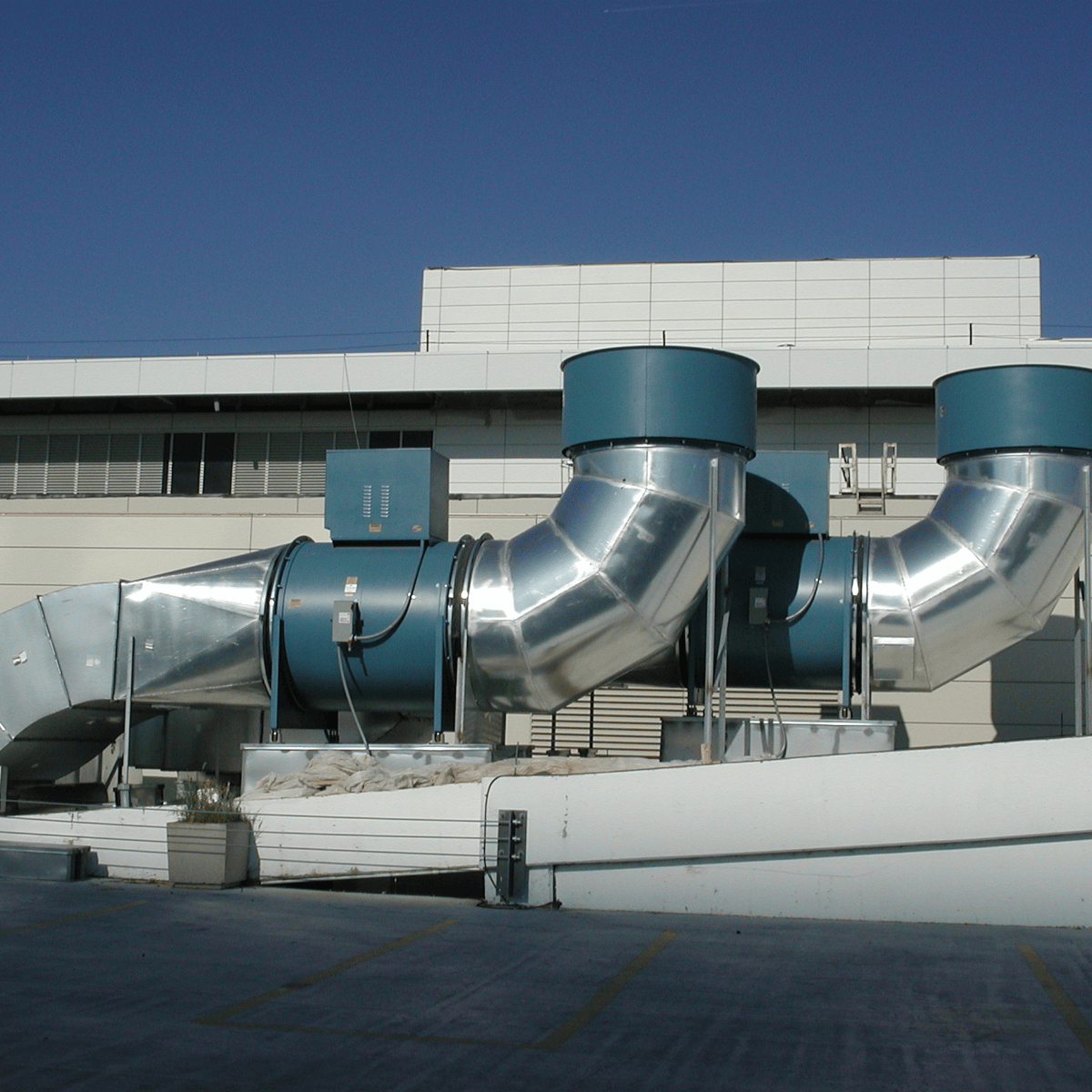
In wastewater treatment, the environment itself also needs to be part of the fan selection.
Hydrogen sulfide is a common concern around wastewater collection and treatment processes. Combined with moisture and other environmental conditions, H₂S can contribute to extremely corrosive conditions.
Fans may also be exposed to chlorine compounds, chemical treatment processes and other contaminants depending on where they are installed.
The result can be corrosion of fan housings, wheels, shafts, fasteners and other components.
And the problem isn't necessarily limited to what's traveling through the fan.
A fan installed outdoors, in a wet well area, near chemical treatment equipment or inside a corrosive building may be exposed to aggressive conditions on both the inside and outside of the equipment.
That's an important distinction when choosing between painted or coated metal and a corrosion-resistant material such as FRP.
Why Use FRP Fans in Wastewater Treatment?
FRP is fundamentally different from protecting carbon steel with a coating.
With coated steel, corrosion resistance depends heavily on maintaining that protective barrier. If the coating is damaged, worn or improperly applied, the underlying metal may become exposed to the environment.
With a properly selected FRP construction, corrosion resistance is inherent to the material system itself.
That makes FRP particularly attractive for equipment expected to spend years operating in wet, corrosive environments.
Other advantages can include:
Excellent corrosion resistance
Resistance to a wide range of chemicals
Lower weight than many metallic alternatives
No need to rely solely on an external protective coating
Long service life when the resin system is properly matched to the application
That last point is important.
Not all FRP is the same.
Resin Selection Matters
Calling for an “FRP fan” doesn't finish the material selection.
The resin system used to manufacture the fan needs to be compatible with the chemicals, concentrations and temperatures the equipment will encounter.
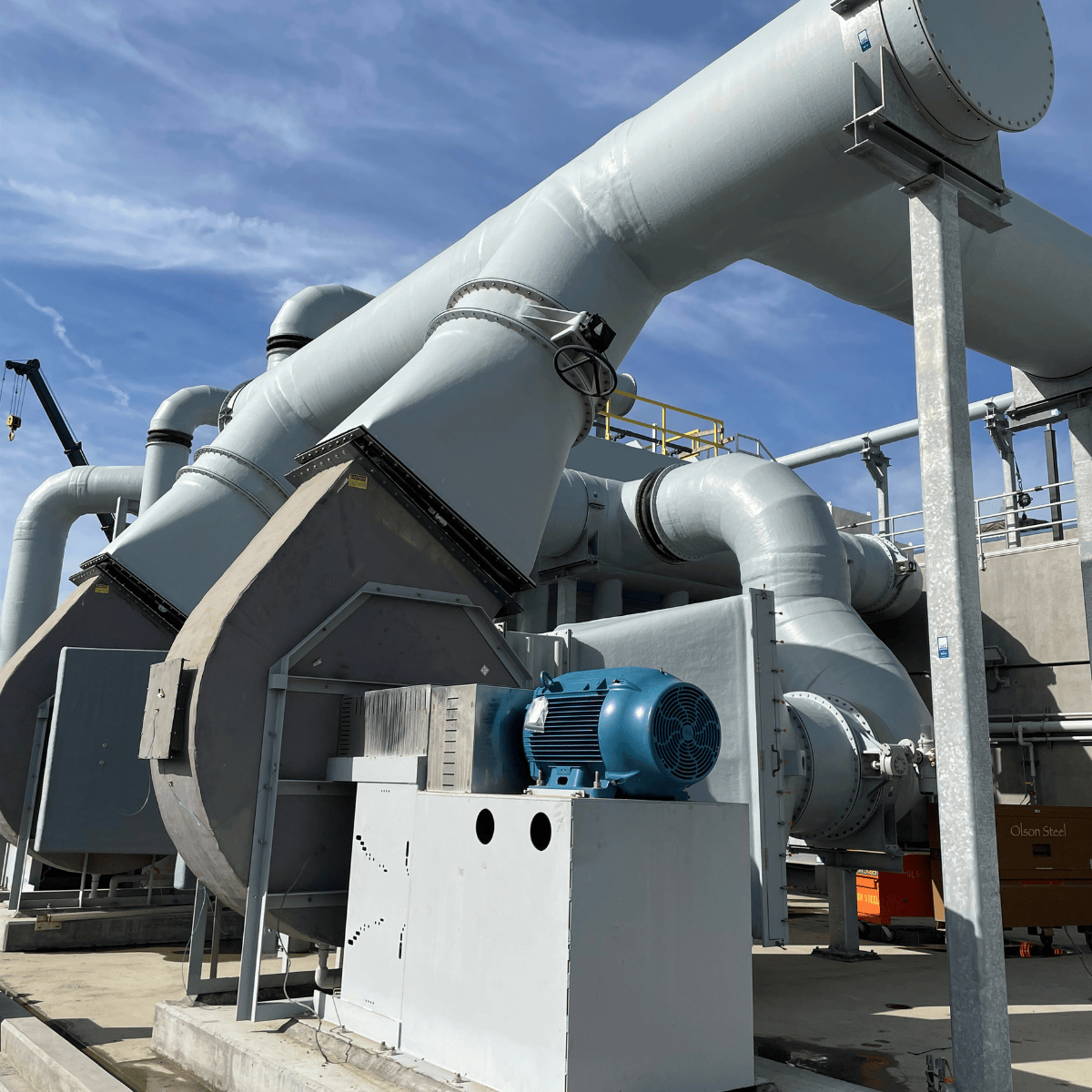
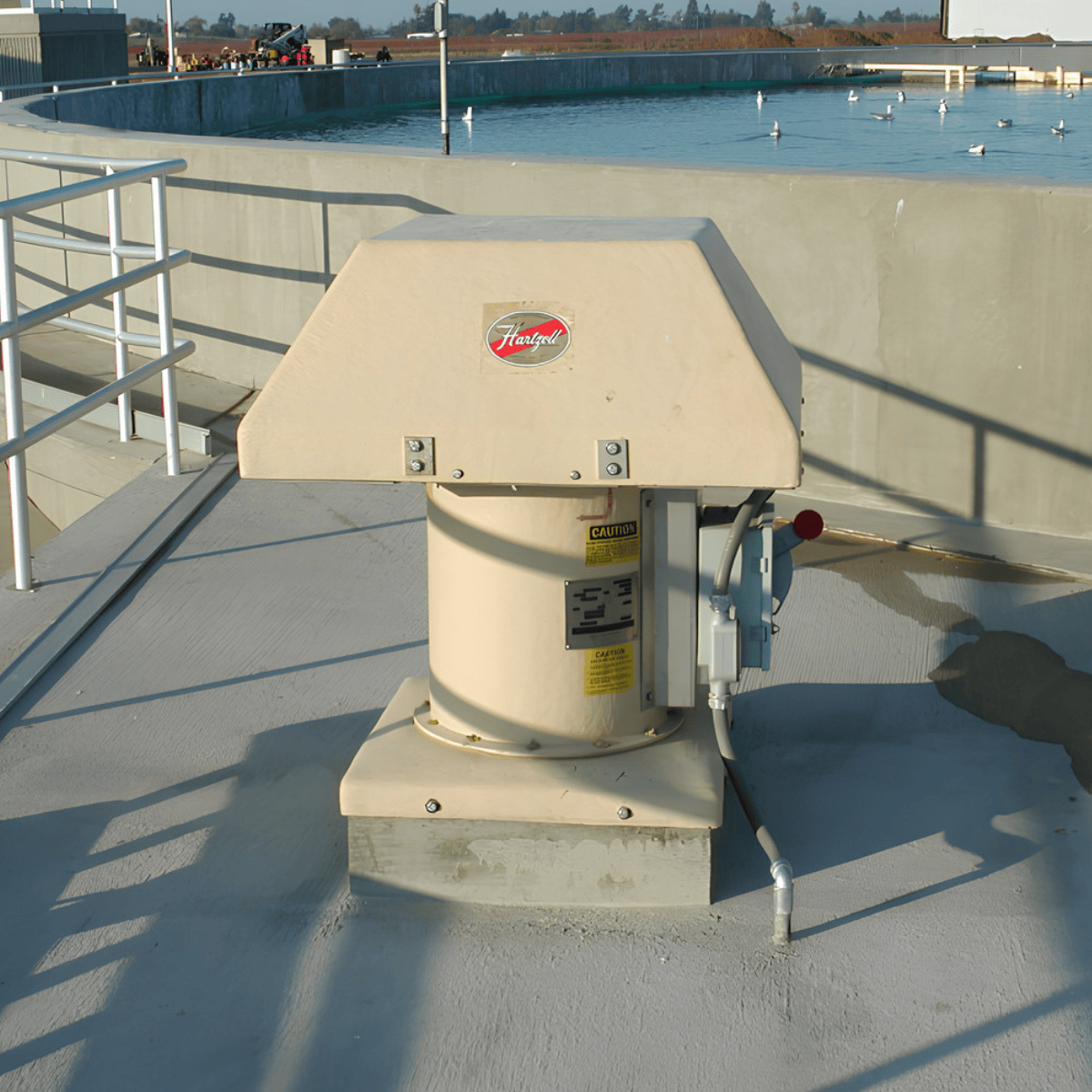
That's why we want to understand the actual application before making a selection.
What chemicals are present? What are their concentrations? What is the maximum temperature? Is exposure continuous or intermittent? Is the contaminant in the airstream, surrounding environment, or both?
For a relatively straightforward wastewater exhaust application, the answer may be simple. More aggressive chemical exhaust applications may require a closer review of resin compatibility.
The goal isn't simply to specify fiberglass.
It's to specify the right fiberglass construction for the environment.
Common Wastewater Applications for FRP Fans
We see FRP fans used throughout wastewater treatment facilities, including:
Odor-control and foul-air systems
Fans move contaminated air from wet wells, headworks and process areas into scrubbers or other odor-control equipment.
Scrubber exhaust
FRP fans are a natural fit around chemical and biological scrubber systems where moisture and corrosive contaminants are expected.
Wet wells and pump stations
These areas can combine high humidity, H₂S and continuous exposure to wastewater-related contaminants.
Chemical storage and treatment areas
Chemical feed and treatment processes can create additional corrosion concerns beyond those normally associated with wastewater.
General building and process exhaust
Even when the fan isn't handling a concentrated chemical stream, the atmosphere inside certain wastewater buildings can be aggressive enough to justify corrosion-resistant construction.
Depending on the duty point and system design, these applications may use either FRP centrifugal fans or FRP axial fans.
Don't Select a Wastewater Fan on CFM and Static Pressure Alone
One of the biggest mistakes in corrosive fan applications is treating material selection as an afterthought.
Two fans may both be capable of producing the same airflow and pressure, but that doesn't mean they'll provide the same service life in a wastewater environment.
A good wastewater fan selection should consider:
Required airflow (CFM)
Static or total pressure
Operating temperature
Airstream composition
Chemical concentrations
Moisture content
Indoor vs. outdoor installation
Continuous vs. intermittent operation
Motor location and enclosure
Hazardous-area requirements, where applicable
Spark-resistant construction requirements
Accessibility and maintenance requirements
We also want to know what's happening immediately before and after the fan.
Poor inlet conditions, elbows located too close to the fan, dampers and other system effects can significantly change how a fan performs once installed.
A corrosion-resistant fan still needs to be a properly selected fan.
What About Spark-Resistant Construction and Static Electricity?
This is another area where the application deserves a closer look.
Specifying FRP does not automatically answer every question regarding static electricity, grounding, hazardous locations or spark-resistant construction.
If the airstream may contain flammable gases or vapors, the entire application needs to be reviewed accordingly.
Fan construction, grounding provisions, motor classification and other system components may all need consideration depending on the process and applicable codes.
This is particularly important in wastewater applications where methane or other potentially combustible gases may be present.
Rather than assuming a standard construction is appropriate, these requirements should be identified before the fan is selected.
Replacing an Existing Corroded Wastewater Fan?
You don't always need a perfect original specification to start a replacement project.
If an existing wastewater fan is reaching the end of its life, we can often begin with:
A photo of the fan
Manufacturer and model number
Nameplate information
Existing drawings
Wheel diameter and arrangement
Motor horsepower and speed
Duct dimensions
Known airflow and static pressure
Information about the process and airstream
From there, we can work backward to understand what the existing equipment was designed to do and determine whether duplicating it—or making a change—makes the most sense.
This is also a good opportunity to ask an important question:
Why did the old fan fail?
If corrosion destroyed a carbon-steel fan, replacing it with another carbon-steel fan may simply restart the clock.
A replacement project is an opportunity to evaluate whether FRP, another material of construction, or a different fan configuration could provide better long-term reliability.
Hartzell FRP Fans for Wastewater Applications
Hartzell Air Movement manufactures industrial centrifugal and axial fans for demanding corrosive environments, including FRP fan designs used throughout wastewater treatment and odor-control systems.
BA Associates represents Hartzell Air Movement throughout New Hampshire, Maine and Vermont.
We can help with new fan selections, replacement fans, existing fan identification, FRP applications and critical spare parts.
Have a wastewater fan that's corroding or becoming a maintenance problem?
Send us a picture of the fan and nameplate along with whatever operating information you have.
You don't need to have the entire application figured out before contacting us. That's what we're here to help with.