
Small Pump. Critical Job. How Stainless Steel Pumps Support Industrial 3D Printing
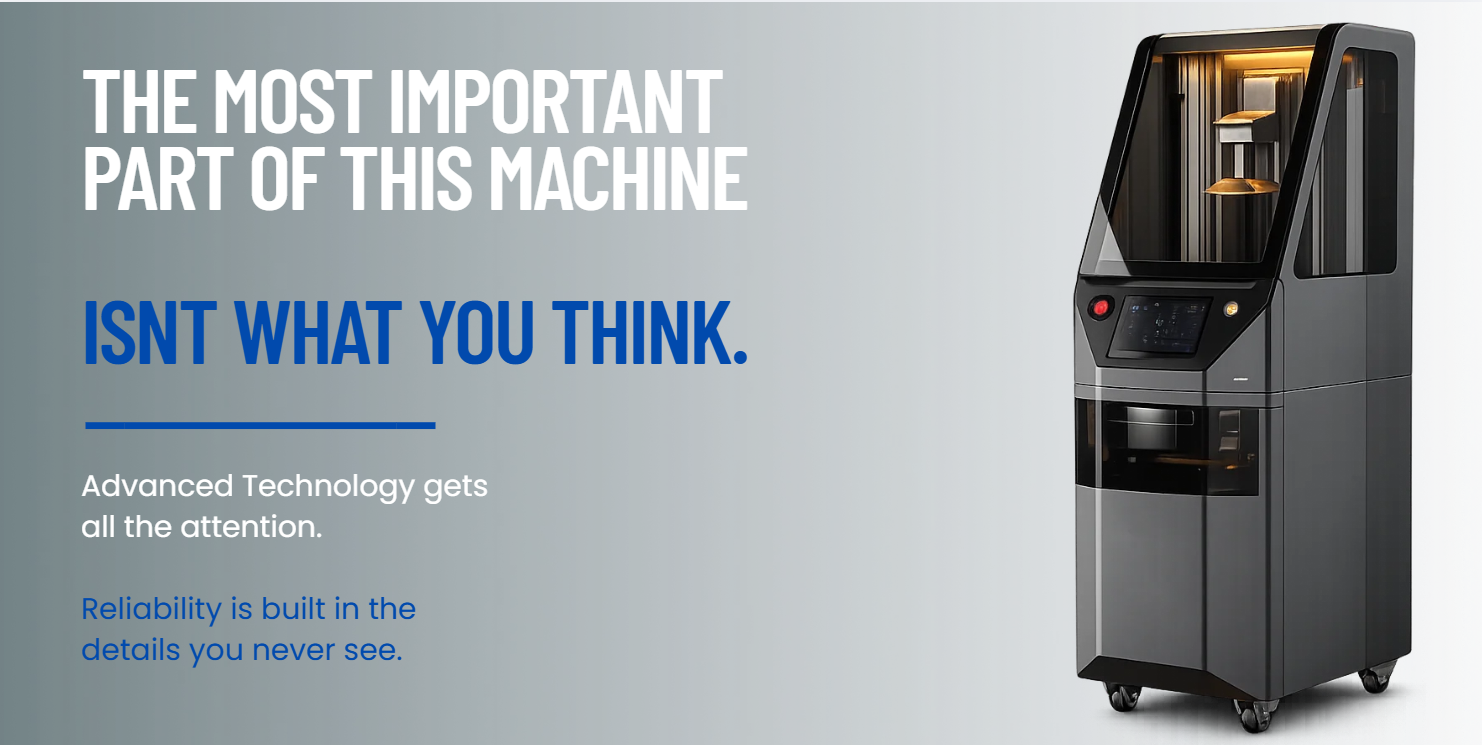
When people think about industrial 3D printing, the first things that come to mind are advanced materials, precision motion systems, lasers, optics, and sophisticated software.
What usually doesn't get much attention is the equipment working behind the scenes to keep the entire process running reliably.
One of those components is the cooling pump.
We recently supplied an American Stainless Pumps (ASP) centrifugal pump for integration into an industrial 3D printing system. The pump is installed vertically within the machine and serves as part of the printer's internal cooling loop.
It isn't the most visible component of the system, but it performs a critical job.
Why Cooling Matters in Industrial 3D Printing
Industrial additive manufacturing equipment can generate a significant amount of heat. Depending on the printing technology, heat may come from lasers, electronics, motors, power supplies, process equipment, or other components operating inside the machine.
That heat needs to go somewhere.
A properly designed liquid cooling loop continuously removes heat from critical components and transfers it to a heat exchanger, chiller, or other heat-rejection device.
The basic loop may look simple:
Pump → Process Equipment → Heat Exchanger/Chiller → Pump
But reliable temperature control can have a direct impact on machine performance, process repeatability, component life, and equipment uptime.
That makes pump selection more important than simply finding something that produces the required GPM.
Why Use a Stainless Steel Pump?
OEM equipment presents a different set of challenges than a traditional industrial pump installation.
The pump often needs to fit inside an existing machine envelope while meeting specific requirements for flow, pressure, materials of construction, electrical characteristics, orientation, reliability, and serviceability.
In this application, an American Stainless Pumps centrifugal pump provided a compact stainless steel solution that could be incorporated directly into the OEM's equipment.
Stainless steel construction can be particularly attractive for closed-loop cooling systems because it provides excellent corrosion resistance while offering a clean, durable solution for industrial equipment.
Depending on the application, these pumps can be used with water, water/glycol mixtures, and other compatible cooling fluids.
Pump Selection for OEM Cooling Loops
Selecting a pump for an equipment cooling loop starts with the actual system—not just the connection size on the pump.
Some of the most important design parameters include:
Required flow rate
Total system pressure drop
Cooling fluid and glycol concentration
Fluid operating temperature
Available NPSH
Pump orientation
Available installation space
Motor voltage and frequency
Materials of construction
Mechanical seal compatibility
Continuous-duty requirements
This becomes especially important with water/glycol systems.
Increasing glycol concentration changes the fluid's viscosity and specific gravity. Those changes can affect pressure loss, pump performance, motor load, and ultimately the operating point of the system.
The correct pump is therefore the pump that operates at the required flow and head under the actual system conditions.
Designed Into the Machine
One of the interesting aspects of this installation is the pump orientation.
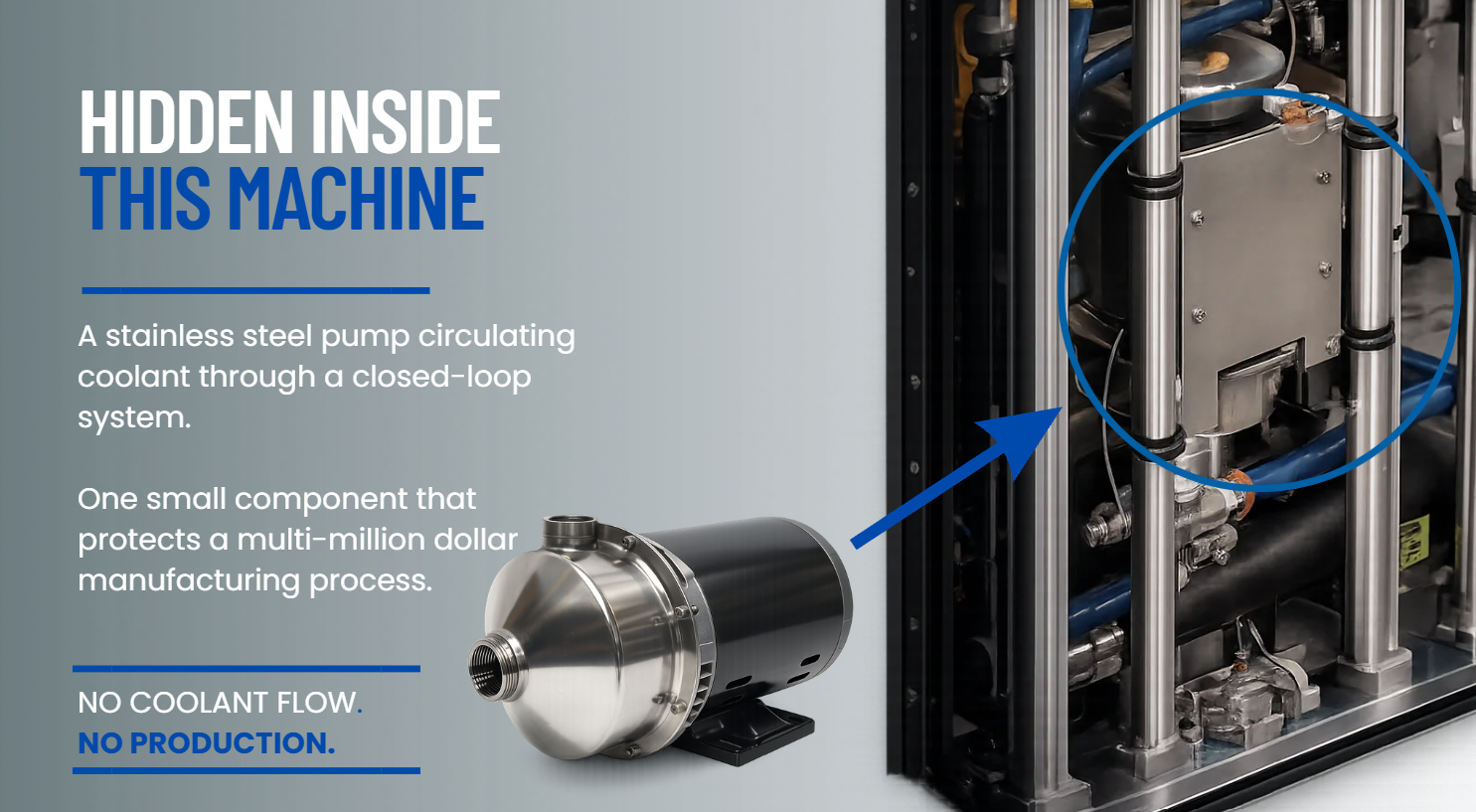
Rather than being mounted conventionally on a floor or skid, the pump is installed vertically as part of the machine itself.
That's a good example of what OEM pump applications often require.
The pump isn't a standalone piece of plant equipment. It becomes another engineered component inside a much larger system.
Space matters.
Connection locations matter.
Motor orientation matters.
Service access matters.
And the pump still has to reliably hit its hydraulic duty point.
The Infrastructure Behind Advanced Manufacturing
Industrial 3D printing may represent some of the most advanced manufacturing technology being developed today, but it still depends on fundamental engineering systems to work.
Pumps move cooling fluid.
Heat exchangers remove heat.
Fans move air.
Motors provide mechanical power.
Controls tie everything together.
The technology at the center of the machine may be revolutionary, but its reliability often depends on getting these supporting systems right.
That's where experience with industrial pumps and heat-transfer equipment becomes valuable.
Need a Pump for an OEM Cooling Application?
BA Associates works with OEMs and industrial customers to select pumps and heat-transfer equipment for cooling loops, process equipment, machinery, and packaged systems.
We represent American Stainless Pumps and can assist with pump selection based on the actual operating conditions of the system, not simply a model number or connection size.
Whether you're designing a new machine, developing a liquid cooling loop, or trying to replace an existing pump, we can help evaluate the application and determine the appropriate pump configuration.
Applications include:
Industrial 3D printers • OEM equipment cooling • Water/glycol circulation • Laser cooling • Electronics cooling • Process cooling • Chiller systems • Packaged equipment • Closed-loop cooling systems • Industrial machinery