When a 30-Year-Old Industrial Blower Finally Reaches the End of the Line
Every industrial facility has one.
The piece of equipment that's been running so long that nobody remembers exactly when it was installed. It's survived maintenance shutdowns, production increases, countless repairs, and years of demanding service.
Until one day...
It doesn't.
That's exactly what happened at a commercial bakery when a centrifugal blower that had been operating for approximately 30 years finally reached the end of its service life.
The blower housing had suffered severe deterioration from decades of heat, moisture, and continuous operation. At first glance, replacing it sounded simple.
It wasn't.
The Easy Part Was Finding the Problem
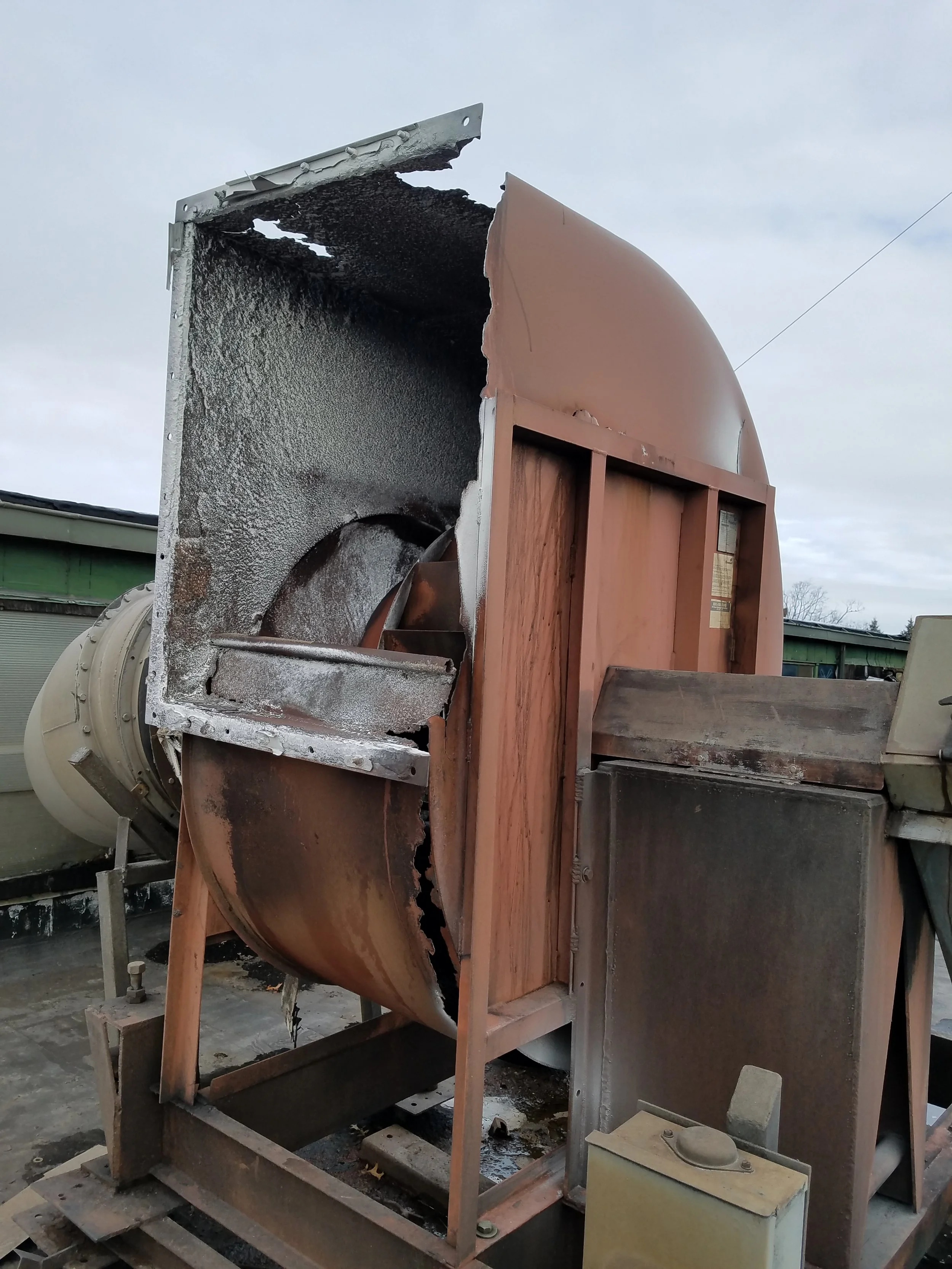
When we arrived on site, the blower had clearly reached the end of its useful life.
The housing had deteriorated significantly, internal components showed extensive wear, and continued repairs simply weren't practical.
Sometimes equipment can be rebuilt.
Sometimes replacement is the only economical solution.
This was one of those cases.
The Hard Part Was Finding a Replacement
Many industrial facilities operate equipment that has outlived the company that originally built it.
Over the years manufacturers merge, product lines change, model numbers disappear, and engineering documentation is lost.
That means replacing an existing blower often becomes an engineering exercise—not a catalog lookup.
Our job wasn't simply selling a new blower.
It was determining exactly what the original blower was doing.
Reverse Engineering the Application
Before recommending a replacement, we worked through several critical questions:
What airflow was the original blower producing?
What static pressure was the system operating against?
What process temperatures would the blower experience?
Could the existing motor and drive arrangement be reused?
Would the new blower fit the existing ductwork and foundation?
Could installation be completed with minimal downtime?
These questions are often more important than selecting the blower itself.
A replacement that doesn't match the original system can create vibration, reduced airflow, higher energy consumption, or premature equipment failure.
Why Crossovers Matter
Many facilities still operate legacy blowers from manufacturers that no longer exist or whose product lines have changed dramatically.
Finding an equivalent replacement requires more than matching physical dimensions.
Performance must also be matched.
That means evaluating:
Fan curve
Wheel diameter and width
Rotational speed
Brake horsepower
Materials of construction
Bearing arrangement
Shaft design
System operating point
Even small differences can have a significant impact on system performance.
A Modern Solution
After reviewing the application, we cross-referenced the existing blower to a new American Fan Company centrifugal blower.
American Fan manufactures heavy-duty industrial fans designed for demanding applications across food processing, manufacturing, process industries, and industrial ventilation.
Rather than redesigning the entire ventilation system, the goal was to provide a modern replacement that delivered the required performance while minimizing installation time and disruption to production.
For facilities where downtime directly impacts production, that's often just as important as the blower itself.
Not Every Replacement Is an Upgrade, Some Are an Opportunity
Replacing aging equipment isn't simply about restoring operation.
It's also an opportunity to evaluate:
Improved fan efficiency
Updated materials of construction
Modern bearing technology
Reduced maintenance requirements
Improved reliability
Better parts availability
A blower that has provided decades of service deserves a replacement engineered to deliver the next several decades.
Engineering Beyond the Catalog
At BA Associates, we regularly help customers throughout New England replace obsolete pumps, fans, blowers, heat exchangers, and cooling equipment.
Many of these projects involve equipment that is no longer manufactured or supported.
Our role is to evaluate the application, understand how the original equipment performed, and recommend a replacement that integrates into the existing system with confidence.
Whether it's an obsolete industrial blower, a legacy fan from a discontinued manufacturer, or a complete ventilation system upgrade, successful projects begin with understanding the application—not just replacing the equipment.
If you're facing an obsolete blower or need help identifying a replacement for legacy equipment, we'd be happy to help.